

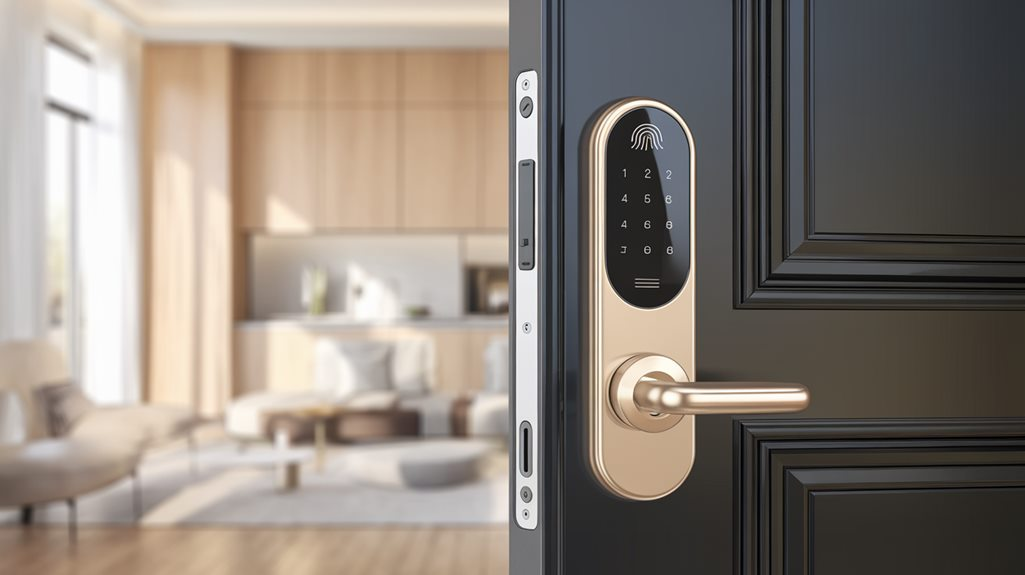
You’re about to discover the latest advancements in smart lock technology that prioritize your safety and convenience. With biometric authentication methods like fingerprint and facial recognition, you’ll enjoy enhanced security and convenience. Remote access and control features allow you to grant access to guests and service providers, and receive real-time notifications. Integration with smart devices enables you to manage your locks via voice assistants or smartphone apps. From keyless entry systems to advanced lock materials, there’s a lot to explore in the world of smart lock technology, and upgrading your home’s security has never been more thrilling – what’s next?
Biometric Authentication Methods
With the rise of smart lock technology, you’re now more likely to find yourself in front of a lock that uses biometric authentication methods, rather than traditional keys or keypads. Biometric authentication involves verifying your identity through unique physical characteristics, such as fingerprints, facial features, or iris scans. For those who need assistance with installing or repairing these smart locks, consider consulting a professional locksmith service to guarantee a reliable and secure locking system. Some locksmith services, like those offered by YH Lock & Security, also provide 24/7 emergency service for residential, automotive, and commercial lockouts.
You’ll likely encounter fingerprint recognition, which uses a sensor to scan and match your fingerprint to a stored template. Facial recognition is another common method, using a camera to capture and analyze your facial features. Some smart locks also use iris scanning, which examines the unique patterns in your iris to verify your identity.
These methods provide an added layer of security and convenience, as you won’t need to carry keys or remember complex codes. Biometric authentication also eliminates the risk of lost or stolen keys, and you can’t forget your own biometric data.
When choosing a smart lock with biometric authentication, consider factors such as sensor accuracy, storage capacity, and durability to ensure a reliable and secure locking system.
Remote Access and Control
Your smartphone is about to become the ultimate key to your home or office, thanks to remote access and control features in smart lock technology. With just a few taps on your screen, you can grant access to guests, monitor who’s entering and exiting, and receive notifications when someone tries to enter your home or office. Many homeowners and business owners in Las Vegas have taken advantage of these features by installing smart locks like August and Smonet in their properties.
Remote access and control features in smart lock technology offer a range of benefits, including:
- Grant access to guests, service providers, or family members remotely
- Monitor who’s entering and exiting your home or office in real-time
- Receive notifications when someone tries to enter your home or office
Control multiple locks with a single app
- Create custom access codes for different users
This level of control and flexibility can be especially useful for homeowners who rent out their properties on Airbnb or for business owners who need to grant access to employees or contractors. With remote access and control features, you can manage your locks from anywhere, at any time, giving you greater peace of mind and flexibility.
Smart Lock Security Features
When considering smart lock security features, you’re likely looking for strong protection against unauthorized access. Biometric authentication methods, such as fingerprint or facial recognition, offer a high level of security by tying access to a unique physical characteristic.
For businesses and organizations, a master key system can also be an effective solution for managing access to different areas and improving overall security.
Advanced encryption protocols also play a pivotal role in safeguarding your smart lock’s data and communication networks.
Biometric Authentication Methods
A smart lock’s security features are only as strong as its authentication methods, and biometric authentication has emerged as a key player in this area. You’ll want to explore the various biometric options available when selecting a smart lock for your home.
Biometric authentication methods use unique characteristics, such as fingerprints, facial features, or voice recognition, to verify your identity and grant access to your home.
Biometric authentication offers several benefits over traditional key-based or code-based systems. For one, it eliminates the need to recall passwords or carry keys, making it a convenient option. Additionally, biometric data is unique to each individual, making it nearly impossible to replicate or steal.
Some common biometric authentication methods used in smart locks include:
- Fingerprint recognition: utilizes a sensor to scan and match fingerprints
- Facial recognition: employs a camera to capture and analyze facial features
- Voice recognition: utilizes audio recordings to verify voice patterns
- Iris scanning: employs a camera to capture and analyze the unique patterns in your iris
- Hand geometry: utilizes a sensor to scan and analyze the shape and size of your hand
Advanced Encryption Protocols
As you consider the security features of a smart lock, advanced encryption protocols play an essential role in safeguarding your home’s access. These protocols guarantee that data exchanged between the lock and your device remains confidential and secure. When choosing a smart lock, look for one that uses end-to-end encryption, such as AES-256 or TLS. This type of encryption scrambles data, making it unreadable to unauthorized parties.
You’ll also want to check if the lock uses secure communication protocols like Bluetooth Low Energy (BLE) or Wi-Fi. Some smart locks even utilize quantum-resistant encryption, which provides an extra layer of security against potential quantum computer attacks.
Additionally, consider a lock with a secure key exchange, such as Elliptic Curve Diffie-Hellman (ECDH). This ensures that the encryption keys are securely exchanged between devices. By choosing a smart lock with advanced encryption protocols, you can have confidence that your home’s access is protected from potential security threats. Always verify the lock’s encryption protocols and guarantee they meet your security standards.
Integration With Smart Devices
By integrating smart locks with other smart devices, you can access a world of convenience and security. This integration allows you to control your smart lock using voice assistants, such as Alexa or Google Assistant, or through a single app on your smartphone.
You can also set up custom scenes and automations to secure your home when you leave or when you’re sleeping. For example, you can set your smart lock to automatically lock when you leave your house and arm your security system.
Here are some other benefits of integrating your smart lock with other smart devices:
- Control your smart lock remotely, even when you’re not at home
- Grant access to guests or service providers and receive notifications when they enter
- Monitor your smart lock’s activity and battery life through a single app
- Set custom alerts and notifications for specific events, such as when someone tries to force open the door
- Integrate your smart lock with your home’s security system for added protection
Keyless Entry Systems
Keyless entry systems are revolutionizing the way you secure your home. These systems eliminate the need for physical keys, making it more difficult for intruders to gain access to your home through key duplication or lock picking. With a keyless entry system, you can enter your home using a code, fingerprint, or even facial recognition.
Keyless entry systems offer a range of benefits, including increased security and convenience. You’ll never have to worry about losing or misplacing your keys again, and you can grant access to guests or service providers without having to physically hand over a key.
Many keyless entry systems also come with additional features, such as remote monitoring and alerts, so you can stay informed about who’s entering your home and when.
When choosing a keyless entry system, consider the level of security you need and the features that are most important to you. Look for systems that use advanced encryption and secure communication protocols to protect your home and your data.
Advances in Lock Materials
As you explore the latest advancements in smart lock technology, you’ll notice significant improvements in lock materials. Stronger key materials are being developed to provide enhanced security and durability, making them less prone to wear and tear.
Smart metal alloys are also being introduced, offering improved resistance to corrosion and environmental factors that can impact lock performance.
Stronger Key Materials
Recent advancements in lock materials have given manufacturers the opportunity to develop stronger, more durable keys that resist wear and tear. You can now enjoy enhanced security and convenience with the latest key technologies.
When choosing a smart lock, consider the materials used to make the keys. You’ll want keys that can withstand heavy use and harsh environmental conditions. Manufacturers are now using advanced materials, such as:
- Nickel Silver: A strong and resistant alloy that reduces wear and tear on the key and lock
- Brass: A durable material that prevents corrosion and guarantees smooth key operation
- Titanium: A lightweight yet strong metal that enhances key durability
- Stainless Steel: A corrosion-resistant material that extends key lifespan
- Copper: A durable material that reduces friction and ensures smooth key operation
With these advanced key materials, you can enjoy enhanced security and convenience. Stronger keys reduce the risk of breakage and guarantee seamless lock operation, giving you greater peace of mind.
Smart Metal Alloys
You’re about to access the next level of security with smart metal alloys, a game-changing innovation in lock materials. These advanced alloys combine the strength of traditional metals with unique properties that make them ideal for smart lock applications. With smart metal alloys, you can rest assured that your locks will be more resistant to corrosion, wear, and tear, as well as more secure against tampering and forced entry.
Here’s a comparison of smart metal alloys with traditional lock materials:
| Material Properties | Smart Metal Alloys | Traditional Lock Materials |
| Corrosion Resistance | High resistance to corrosion | Prone to corrosion over time |
| Strength-to-Weight Ratio | High strength with minimal weight | Heavy and bulky |
| Durability | Resistant to wear and tear | May degrade over time |
| Security | Tamper-evident and resistant to forced entry | Vulnerable to tampering and forced entry |
These advanced materials are designed to provide you with peace of mind, knowing that your locks are secure and reliable. By incorporating smart metal alloys into your smart lock system, you can take your home security to the next level and enjoy a safer, more secure living space.
Powering Smart Locks Efficiently
Behind the convenience of smart locks lies a more pressing concern: how to power them efficiently. When thinking about investing in a smart lock, it’s crucial to reflect on the power source and its impact on your daily life. A dead battery can make your smart lock inoperative, leaving you locked out of your home.
To efficiently power your smart lock, you’ll want to ponder the following options:
- Battery Life: Look for smart locks with extended battery life, typically lasting between 6 months to a year.
- Low-Power Modes: Some smart locks offer energy-saving modes that can prolong battery life.
- Solar-Powered Options: Explore smart locks with solar-powered batteries that can recharge in sunlight.
- USB-Rechargeable Batteries: Some smart locks use USB-rechargeable batteries, eliminating the necessity for disposable batteries.
- Real-Time Battery Life Monitoring: Select a smart lock with real-time battery life monitoring to make sure you’re always informed of when it’s time to replace or recharge the batteries.
Future of Smart Lock Technology
The future of smart lock technology looks promising, with innovations that prioritize user convenience, enhanced security, and seamless integration with other smart devices. You can expect to see more keyless locks that use advanced biometric authentication methods, such as facial recognition and fingerprint scanning. These methods will provide an additional layer of security and make it easier for you to grant access to guests or service providers.
Another area of development is in the integration of smart locks with other smart home devices. For example, your smart lock may be able to communicate with your smart thermostat to adjust the temperature when you enter or leave your home. This type of integration will make your home more convenient and energy-efficient.
As the Internet of Things (IoT) continues to grow, you can also expect to see more smart locks that use artificial intelligence (AI) and machine learning (ML) to learn your habits and preferences. This will enable your smart lock to make recommendations and automate tasks, making your life easier and more convenient.
