

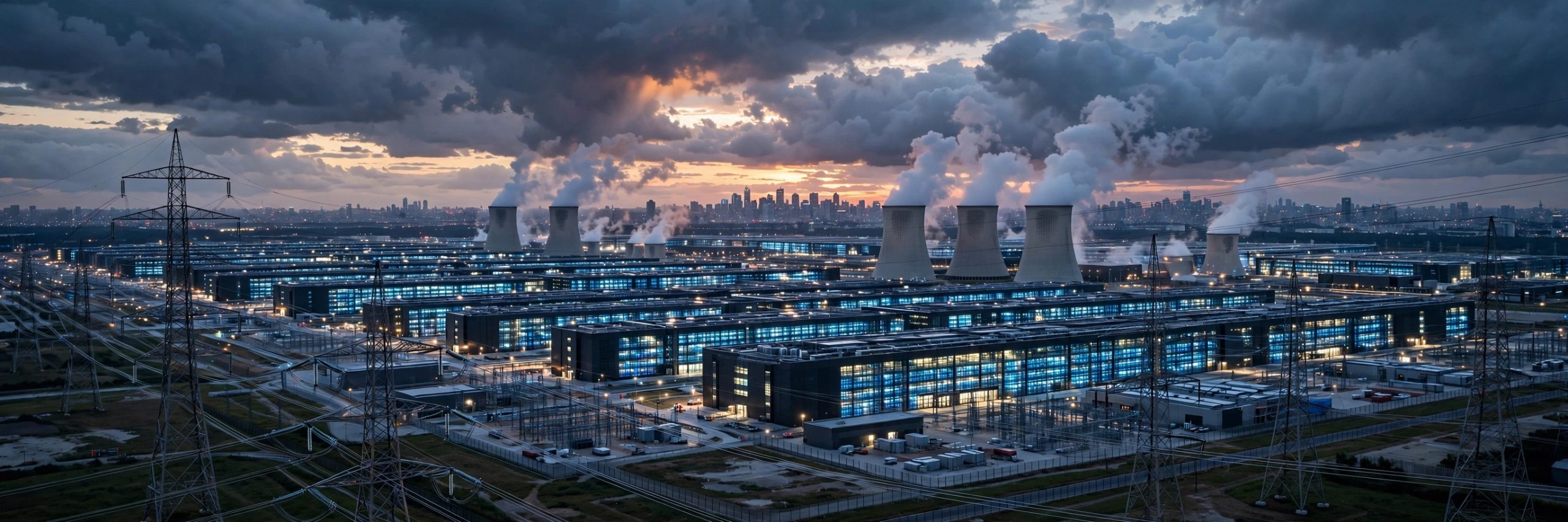
The artificial intelligence boom has entered its most expensive phase yet. Across the United States and beyond, technology companies are committing hundreds of billions of dollars to new data centres, power contracts and specialised chips, betting that demand for AI computing will keep climbing for years. A fresh wave of analyst forecasts, however, is raising an uncomfortable question: the spending is now forecast to outstrip the revenue the industry expects AI to generate in the near term, and the gap between the two numbers is getting harder to ignore.
The Numbers Behind the Building Frenzy
Data centres are the factories of the AI age. Each new facility is packed with graphics processors that train and run large language models, and each one consumes as much electricity as a small city. Hyperscalers have responded by announcing campus after campus, signing long-term energy deals and racing to secure land near power grids. One widely discussed estimate even suggested that paying for the current wave of AI infrastructure at today’s wages would take the equivalent of 250 million jobs, in a country that has roughly 159 million workers — a vivid way of showing just how large the capital commitments have become.
Investors have so far rewarded the spending, pushing the valuations of chipmakers, cloud providers and construction suppliers to record levels. But forecasts covered this week suggest infrastructure outlays are on course to grow faster than the subscription, advertising and enterprise revenue that AI products currently bring in. That does not make the investment irrational — railways, fibre-optic networks and cloud computing all went through periods of overbuilding — but it does change the risk calculation for everyone involved.
Why Companies Say the Spending Has to Happen
Executives argue that the alternative is worse. Computing capacity is the bottleneck for every new AI feature, from coding assistants to video generation, and companies that underbuild risk losing customers to rivals with faster, cheaper models. There is also a hardware logic to moving early: the newest chips are dramatically more efficient than the previous generation, so a data centre built today can serve more users per watt than one built three years ago. Our recent look at why your next phone will think locally showed the other side of the same trend, as smaller models move onto consumer devices and relieve some of the pressure on centralised servers.
Energy has become the second race. Several operators are funding restarted nuclear plants, new solar farms and experimental geothermal projects simply to guarantee supply. Local communities, meanwhile, are asking harder questions about water use, electricity prices and tax breaks, turning what used to be a quiet construction decision into a political one.
Where the Revenue Is Supposed to Come From
For the maths to work, AI revenue has to broaden beyond a handful of flagship products. Enterprise software is the biggest hope: companies are paying for AI features bundled into office tools, customer-service platforms and security products, and those contracts renew every year. Developers are another growing market, paying per call for model access. Consumers, by contrast, have been slower to pay directly, with most chatbot usage still on free tiers subsidised by the very companies building the infrastructure.
Analysts at The Register, reporting on the latest forecasts, note that the shortfall is a timing problem as much as a demand problem: the buildings and chips are paid for now, while the revenue they enable arrives over many years. If adoption keeps doubling, the gap closes. If it plateaus, some facilities could sit underused while their hardware ages — and in AI, hardware ages fast.
What Happens If the Bet Goes Wrong
A correction would not look like the dot-com crash in every respect, because today’s spenders are mostly profitable giants funding projects from cash flow rather than borrowed money. Still, the ripple effects would be real: chip orders would be cut, construction jobs would disappear in data-centre towns, and smaller AI startups that rent capacity could face sharply higher prices or, paradoxically, fire-sale rates from operators desperate to fill halls.
There are also second-order effects worth watching. Power-hungry facilities are reshaping electricity markets, delaying the retirement of some fossil-fuel plants while accelerating investment in clean energy and storage. Our coverage of passkeys and the retiring password is a reminder that not every technology shift needs this scale of capital — but the ones that do tend to define the decade that follows.
The Bottom Line for Readers and Investors
The sensible way to read the current debate is neither euphoria nor panic. The spending is real, the revenue gap is real, and both can be true at once in an industry building ahead of demand. The signals to watch over the next year are utilisation rates in new facilities, whether enterprise AI contracts start renewing at higher values, and whether energy costs begin to eat the margins the forecasts assume. If those three indicators hold up, today’s alarming headlines will read, in hindsight, like the growing pains of a platform shift. If they slip, the AI industry may be about to learn the oldest lesson in technology: building it is only half the business — somebody still has to pay for it.
