

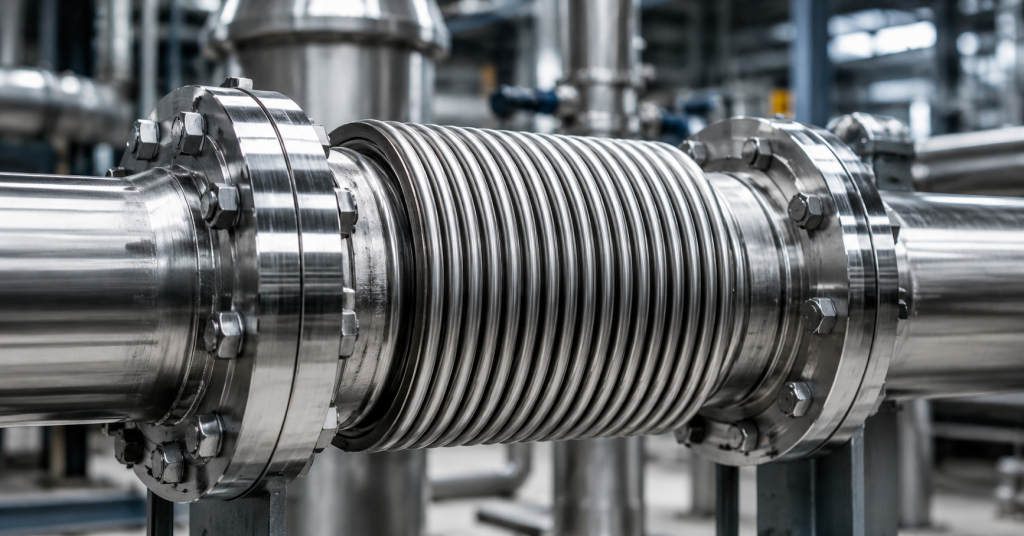
Stainless steel bellows are flexible components used within piping systems to absorb movement, vibration and thermal expansion while maintaining the integrity of the system. They are commonly incorporated into expansion joints, where their corrugated design allows them to compress, extend or flex in response to changes in temperature, pressure or mechanical forces. Their ability to accommodate movement helps reduce stress on connected equipment and pipework, making them an important part of many industrial installations. (belman.com)
The corrugations formed into the bellows create flexibility without sacrificing strength. As pipelines expand and contract during operation, the bellows compensate for these dimensional changes, helping to prevent excessive strain that could otherwise lead to damage or premature wear.
How Stainless Steel Bellows Work
As temperatures rise or fall, metal pipework naturally expands and contracts. Without a method of absorbing this movement, stress can build throughout the system, affecting welds, flanges, pumps and other connected equipment.
Stainless steel bellows are designed to absorb several different types of movement, including:
- Axial movement, where the bellows compress or extend along their length.
- Lateral movement, where the pipe shifts sideways.
- Angular movement, where connected sections rotate slightly in relation to one another.
These movements help maintain system stability while reducing vibration and minimising mechanical stress throughout the installation. Torsional movement is generally avoided, as twisting can reduce the performance and lifespan of metal bellows. (ScienceDirect)
Why Stainless Steel Is Used
Stainless steel is one of the most widely used materials for bellows because it combines strength with flexibility and corrosion resistance. It performs well across a broad temperature range and is suitable for demanding operating environments where durability is essential.
Some of the advantages of stainless steel include:
- Excellent corrosion resistance.
- High strength-to-weight ratio.
- Resistance to elevated temperatures.
- Long service life.
- Compatibility with many industrial fluids and gases.
- Good fatigue resistance under repeated movement.
Different grades of stainless steel may be selected depending on operating temperatures, pressure requirements and the chemicals being transported through the system. (Bellows Systems)
Common Applications
Stainless steel bellows are found across numerous industries where pipework experiences thermal expansion, vibration or pressure fluctuations.
Typical applications include:
Industrial Processing
Manufacturing facilities often operate with high-temperature processes that cause continuous expansion and contraction within pipe systems. Bellows help maintain reliability while protecting connected equipment.
HVAC Systems
Heating, ventilation and air conditioning systems experience repeated temperature changes throughout daily operation. Expansion joints fitted with stainless steel bellows accommodate these movements while helping reduce vibration transmission.
Power Generation
Power stations use extensive pipe networks carrying steam, water and gases at varying temperatures and pressures. Stainless steel bellows help manage thermal movement while supporting long-term system performance.
Chemical Processing
Chemical plants require materials capable of resisting corrosion while maintaining flexibility. Stainless steel provides an effective balance of durability and chemical resistance for many processing environments.
Marine and Offshore Installations
Ships and offshore facilities experience both thermal movement and constant vibration from engines and machinery. Stainless steel bellows assist in protecting connected pipework while coping with demanding operating conditions.
Benefits of Using Stainless Steel Bellows
Selecting the correct expansion joint with stainless steel bellows provides several operational advantages.
Reduced Stress on Pipework
By absorbing movement instead of transferring it throughout the system, bellows reduce stress concentrations at welds, flanges and equipment connections.
Vibration Isolation
Pumps, compressors and rotating machinery generate vibration that can travel through connected pipework. Flexible bellows help isolate these vibrations, reducing wear on surrounding components.
Improved Equipment Protection
Sensitive equipment connected to piping systems benefits from reduced loading caused by thermal expansion or misalignment. This can contribute to improved reliability and lower maintenance requirements.
Accommodation of Installation Tolerances
Minor alignment differences during installation can often be absorbed by stainless steel bellows, reducing the effects of small positioning inaccuracies while maintaining system flexibility. (Teddington Engineered Solutions)
Design Considerations
Choosing the appropriate stainless steel bellows involves more than selecting the correct pipe diameter. Engineers typically evaluate several operating factors before specifying an expansion joint.
Important considerations include:
- Operating pressure.
- Maximum and minimum temperatures.
- Expected movement type and travel distance.
- Flow media.
- Corrosion resistance requirements.
- Number of operating cycles.
- Installation orientation.
- Available space.
Each application places different demands on the bellows, so careful design helps ensure reliable long-term performance.
Maintenance and Inspection
Although stainless steel bellows are designed for durability, routine inspection remains important. Periodic maintenance can identify early signs of wear before they affect the wider piping system.
Inspections commonly check for:
- Surface cracking.
- Corrosion.
- Excessive deformation.
- Damage from external impacts.
- Leakage around welded connections.
- Signs of overextension or compression.
Maintaining proper support for the surrounding pipework also helps ensure the bellows operate within their intended movement limits.
Conclusion
Stainless steel bellows play a vital role in modern piping systems by safely accommodating movement caused by thermal expansion, vibration and mechanical forces. Their flexible corrugated construction enables them to protect equipment, reduce stress within pipework and improve overall system reliability. Whether installed in industrial manufacturing, energy production, HVAC systems or chemical processing facilities, stainless steel bellows provide an effective solution for managing movement while maintaining the integrity and performance of complex piping installations.
