

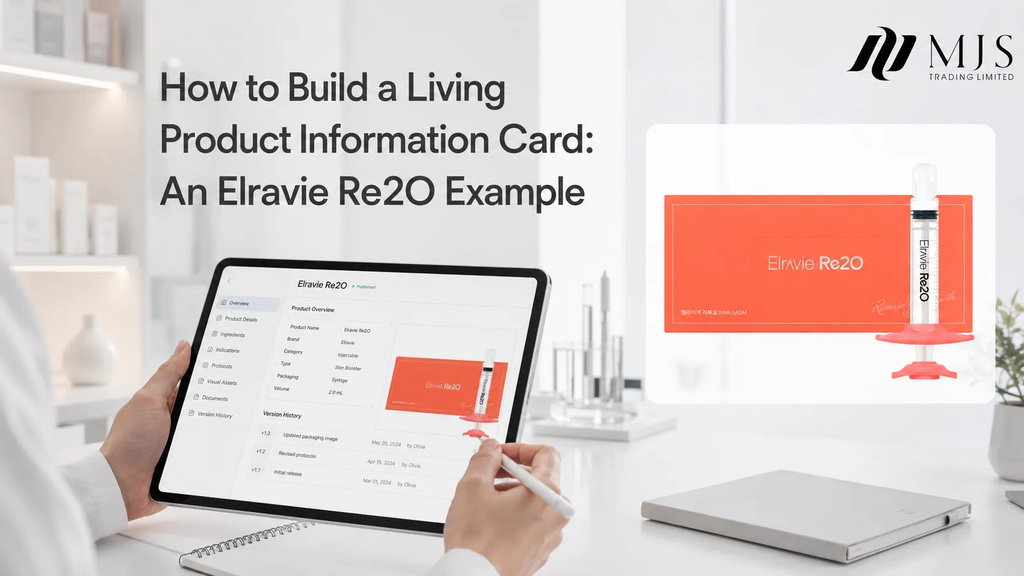
Product information in an aesthetic business changes over time. Packaging images may be replaced, catalogue wording may be revised, supplier contacts may change, and new documents may become available. If those updates are scattered across emails, spreadsheets and saved web pages, staff can easily work from different versions.
A living product information card gives the team one controlled record that can be updated without losing its history. Elravie Re2O provides a useful example because the current product listing presents a distinct product name, labeled presentation and professional-use context that should be recorded separately from marketing interpretation.
The purpose of the card is not to make clinical decisions. It is to preserve identifiable product and purchasing information so procurement, inventory and content teams can refer to the same source.
Start With a Controlled Information Structure
A useful product card system separates stable identity fields from information that changes with each quotation, delivery or review. The team should know who owns every field, which source supports it and when it was last checked.
| Record field | What to capture |
| Identity | Exact commercial name, brand and manufacturer information |
| Presentation | Form, labeled quantity and pack configuration |
| Visual reference | Current front, side and label images |
| Source | Page, supplier document or manufacturer material used |
| Review status | Owner, verification date and open questions |
| Version history | What changed, when and who approved the update |
Fields should be completed from identifiable sources. Supplier statements, packaging, invoices, manufacturer materials and regulator databases serve different purposes; the record should not imply that one source proves everything about a product.
A Practical Workflow
The following sequence can be adapted to Elravie Re2O while keeping clinical and regulatory decisions with appropriately qualified professionals:
- Create a unique internal record rather than using the page title as the database key.
- Transcribe packaging information exactly and keep interpretation in a separate field.
- Store the current visual reference without overwriting earlier approved images.
- Record the source and date for every material update.
- Route clinical or regulatory questions to appropriately qualified reviewers.
- Publish an approved version to the teams that need it.
Use Catalogue Research Carefully
During early research, teams may review Elravie Re2O to understand how the product or category is presented. That commercial reference should be followed by the organization’s own verification, approval and destination-market checks.
Availability on an international website does not by itself establish that a product may be imported, supplied or used in a particular jurisdiction. Requirements can differ by product, intended use and market.
Keep Evidence and Marketing in Separate Fields
Product identity, ingredient or composition statements, promotional wording and evidence-based conclusions should not be merged. A disciplined record shows what the source actually says and avoids converting a catalogue statement into a medical conclusion.
Where a claim affects safety, professional use, authorization or clinical interpretation, it should be escalated to the appropriate qualified reviewer. General operations staff can preserve and route information without independently validating a clinical conclusion.
Common Mistakes to Avoid
- Copying promotional wording into a factual specification field
- Treating an undated screenshot as permanent evidence
- Replacing an old file without retaining a change history
- Combining products with similar names into one record
- Assuming international availability equals local authorization
Build Records That Can Be Updated
A useful record has an owner, review date and change history. New information should create a documented revision rather than silently replacing the previous version. Open purchase orders and inventory records should be checked whenever a material field changes.
For broader catalogue and enquiry context, teams can also review MJSBeautys. The same internal controls should be applied regardless of which catalogue or supplier is being considered.
Frequently Asked Questions
Why use a structured record instead of email?
A structured record makes the same fields searchable and comparable. Email can remain supporting evidence, but it should not be the only place where a decision or product detail is stored.
Who should own updates?
Ownership depends on the field. Procurement may own quotations, inventory staff may own receiving data, and qualified clinical or regulatory reviewers should own conclusions within their scope.
How often should the information be reviewed?
There is no universal interval. The organization should set a risk-based schedule and also trigger review when packaging, suppliers, documents, availability or applicable requirements change.
Can a catalogue page confirm local authorization?
No. Catalogue availability and local authorization are different questions. Buyers should use the official sources and professional advice applicable to their destination market.
A Practical Next Step
Begin with one recently updated product and compare every place where its information appears. The differences will show which fields need an owner and a formal update rule.
The strongest systems are not the most complicated. They are the ones that let another authorized employee understand what was recorded, where it came from, what remains uncertain and what action should happen next.
