

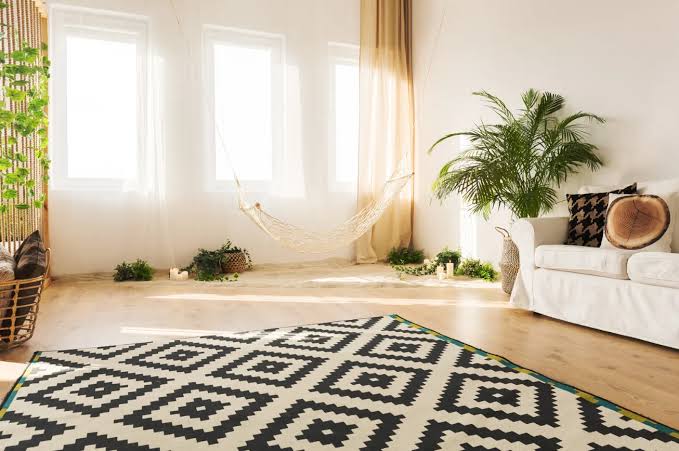
You’ve stared at your bare floor long enough. It’s cold, a little echoey, and somehow makes the space feel like an unfinished waiting room. Now, you’re faced with the age-old dilemma: do you go all in with wall-to-wall carpeting or keep things flexible with an area rug?
Both are perfectly valid choices. But ‘valid’ doesn’t mean ‘right for you,’ and picking the wrong one is the kind of mistake you’ll be living with for years. So, let’s break down how the two stack up.
What Are You Actually Choosing Between?
Before you start weighing the pros and cons, it helps to be clear about what these two options actually are, because they serve slightly different purposes.
An area rug is a loose covering that sits on top of your existing flooring. It defines the space, adds warmth, and can be moved, swapped, or rolled up and taken with you when you move house.
Wall-to-wall carpeting, on the other hand, is installed directly onto the subfloor and covers an entire room edge to edge. It’s a commitment. So, think of it as a permanent design decision—one that’ll outlast most of your other choices.
Let Your Existing Floor Guide the Decision
Before you think about rugs or carpeting, take a look at what’s already under your feet.
If you’ve got hardwood, tile, or laminate that’s still in good condition, an area rug usually makes more sense. Those floors already look good on their own, so covering them completely with glue, underlay, and wall-to-wall carpet can feel a bit like hiding a perfectly nice feature.
But if the floor underneath is worn, uneven, or simply past saving, wall-to-wall carpeting can be the better option. It’ll smooth over these imperfections and give the whole room a clean, consistent finish.
You’ll see this quite a lot in older UK homes. The original floorboards can be charming, but they’re often draughty or too damaged to refinish without spending a small fortune, so carpeting ends up being the more practical solution.
Factor in Comfort and Heat Retention
This is where wall-to-wall carpeting pulls ahead, especially in bedrooms, where you’ll appreciate that extra warmth underfoot.
It acts as a thermal layer, trapping warm air and reducing the cold that rises through the floor, which is particularly helpful in older properties without underfloor heating.
Over a British winter, that insulation effect can noticeably reduce heating costs. And since your radiator is already working hard enough, every bit of warmth that stays in the room takes some pressure off it.
Area rugs do add a bit of warmth underfoot, especially in the spots where you walk the most. The issue is that they don’t cover the entire floor. The exposed edges still let cold air creep in, which takes away some of the comfort you’re trying to create.
So, if staying warm and improving energy efficiency are high on your list, a fitted carpet is usually the more sensible long-term choice.
Consider the Noise Level in Your Space
This is another question you need to ask yourself before settling on anything: how quiet do you want your home to be?
Wall-to-wall carpeting is much better at absorbing sound. It softens footsteps, muffles everyday noise, and generally makes a space feel calmer. If you live in a mid-terrace house or a block of flats, it can also make life a bit more peaceful for whoever happens to live below you.
Area rugs do help with sound, but only where they actually sit. Step off the rug onto bare flooring, and you’re right back to hearing the click of heels or the thud of a dropped remote echo across the room.
If you have an open-plan space with hard flooring, this is where it becomes obvious. Without a soft surface to absorb sounds, the room can start to feel surprisingly echoey.
Decide How Much Flexibility You Want
This is arguably the most important distinction between the two.
Area rugs are flexible by nature. You can move them between rooms, rotate them to even out wear, swap them seasonally, or take them with you when you move. If you redecorate every few years, that kind of freedom is genuinely valuable.
Wall-to-wall carpeting is fixed. Once it’s down, changing it means ripping it up—a messy, disruptive, and often costly process.
If you’re renting, this likely isn’t even an option. But if you own your home and expect to stay put for a while, that long-term setup isn’t necessarily a downside.
So, the question you should ask yourself here is pretty simple: how much do you like having the option to change your mind?
Plan for Ongoing Upkeep
Neither option is completely maintenance-free, but the kind of work involved is a bit different.
With an area rug, everyday care is fairly simple. You need to vacuum it regularly and, depending on the size and material, you can take it outside for a shake or send it off to a specialist cleaner when it needs a deeper refresh.
Smaller rugs are especially manageable since you can deal with them without much hassle.
Wall-to-wall carpeting is a little less forgiving. You’ll need to hoover the entire room consistently, and if something spills, it’s best to deal with it straight away before it works its way into the pile.
Because it can’t simply be lifted or moved, you’ll also need to bring in domestic carpet cleaning services every 6 to 12 months to keep allergens under control.
Compare the Upfront and Long-Term Costs
Area rugs are generally cheaper to buy and require no installation cost whatsoever. You place them yourself, adjust them as needed, and replace them when they wear out, which, for a quality rug, might be many years down the line.
Wall-to-wall carpeting involves a higher upfront spend. You pay for materials across a larger area, professional fitting, and underlay. That adds up quickly, especially in bigger rooms.
That said, fitted carpets can make sense over the long run. The extra insulation can help keep heating costs down, and a good-quality carpet can last many years if it’s looked after properly.
Neither option is automatically cheaper. In the end, it really comes down to the style you prefer and how long you expect it to last in your home.
Look at the Materials and Their Impact
If sustainability matters to you, it’s worth looking a little closer at the materials involved.
Area rugs made from natural materials, like wool, jute, and cotton, are biodegradable and often more sustainably produced. They can be reused, repurposed, or recycled, which gives them a clear environmental edge.
Most wall-to-wall carpets, on the other hand, are made from synthetic fibres that aren’t biodegradable and typically end up in landfills.
If you prefer fitted carpets, it’s still possible to make a more responsible choice. Some brands now use recycled materials or offer take-back schemes so old products can be properly processed at the end of their lifespan.
That said, the biggest sustainability factor is often the simplest one: buy something well-made and keep it for as long as possible.
Conclusion
At the end of the day, there’s no universally correct answer here—only the right one for your specific situation.
So, run through what matters most to you: warmth, flexibility, noise reduction, and cost. The option that ticks the most boxes is the one worth going with. Trust us, it’s as simple as that.
