

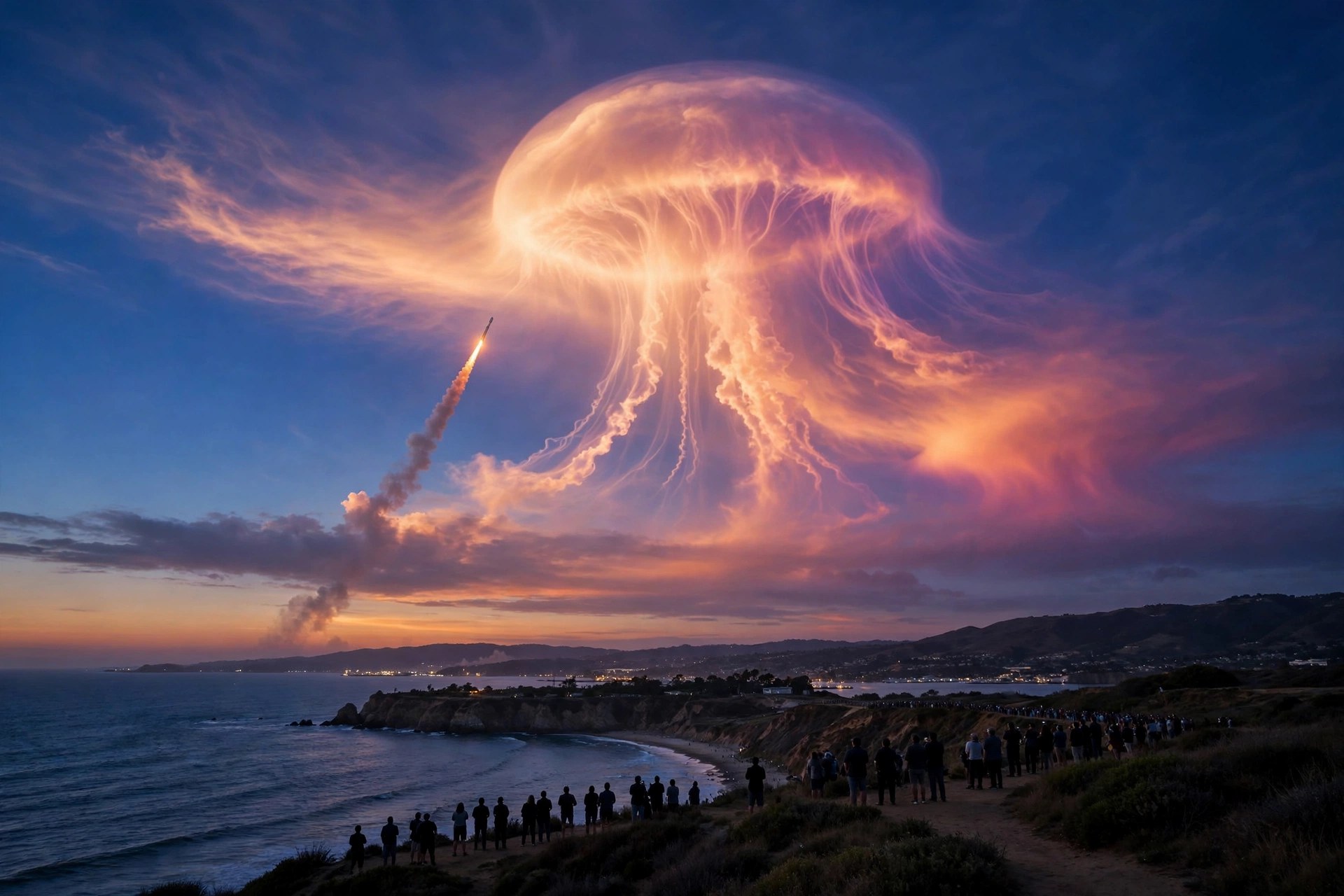
Drivers along the US east coast looked up this week to find something extraordinary in the twilight sky: a vast, glowing, jellyfish-shaped cloud drifting high above the horizon, its translucent tendrils lit in shades of blue, pink and gold. Photos of the phenomenon spread quickly across social media, where it was variously described as a comet, a portal and — inevitably — a UFO. The real explanation is almost as spectacular: it was the exhaust plume of a SpaceX rocket, caught by sunlight at exactly the right moment.
How a Rocket Launch Creates a ‘Jellyfish’
The effect is known to photographers and spaceflight fans as the space jellyfish, and it depends on a precise alignment of timing and altitude. When a rocket launches shortly before sunrise or just after sunset, the ground below is already in darkness while the upper atmosphere is still bathed in sunlight. As the rocket climbs and its engines’ exhaust expands in the thin air high above the Earth, that plume forms a huge, diffuse bubble. Sunlight striking the bubble makes it glow against the dark sky, while the narrower trail below resembles the tentacles of a jellyfish drifting through deep water.
Because the plume expands in near-vacuum conditions, it can grow to an astonishing size — visible, on a clear evening, from hundreds of miles away. That is why reports of this week’s sighting came in from multiple states along the coast, with many witnesses insisting the object must have been directly overhead when it was in fact far out over the Atlantic.
Why This Sighting Drew So Much Attention
Jellyfish clouds have accompanied launches before, including several memorable dawn and dusk liftoffs from Florida and California, but each one still catches the public off guard. Part of the reason is frequency: as launch cadences have accelerated, twilight windows that once produced a sighting every few years now produce several a year. Another part is the modern camera in every pocket. Where earlier generations might have glimpsed a strange glow and moved on, today’s witnesses capture sharp video within seconds and share it with millions, turning a meteorological curiosity into a trending topic before the rocket has even reached orbit.
Reporting by The Guardian described the cloud as visible across a wide stretch of the east coast, with skywatchers posting images throughout the evening. Astronomers were quick to explain the phenomenon online, and several noted that the same geometry that creates jellyfish plumes also produces the related ‘twilight phenomenon’ seen after missile tests and satellite deployments.
The Science in the Sky
Beyond the spectacle, these plumes are genuinely useful to science. The way exhaust gases expand, freeze and drift at extreme altitude tells researchers about winds and conditions in a layer of the atmosphere that is difficult to study directly — too high for weather balloons, too low for most satellites. Ice crystals forming in the plume can even seed brief, high-altitude clouds similar to the noctilucent clouds that glow over polar regions in summer.
The sight is also a reminder of how much of modern technology now passes overhead unnoticed. The same launch industry putting on light shows is quietly reshaping communications and security — a theme we explored in our article on on-device AI and the phones that think locally, which depend on satellite and data networks that launches like this keep expanding. And as our recent explainer on how sleep trackers are changing what we know about rest showed, the sensors watching us from above and on our wrists are part of one connected story.
How to Catch the Next One
If you want to see a jellyfish cloud yourself, timing is everything. Launches scheduled in the hour before dawn or the hour after dusk offer the best odds, and clear skies with a dark eastern or western horizon — depending on the launch site — make the effect dramatically more visible. Spaceflight calendars are published weeks in advance, and local astronomy groups often flag the most promising twilight windows. Binoculars help reveal the structure of the plume, but the best views are usually with the naked eye, simply because the cloud can span a huge portion of the sky.
Expect more of these sightings, not fewer. Launch rates are still rising, reusable rockets are flying more often, and every twilight mission is a small light show waiting for the right conditions. So the next time a glowing jellyfish blooms over the coast at dusk, you will know what you are looking at: not a visitor from another world, but a postcard from the busiest decade in spaceflight history — written across the sky in sunlight and rocket exhaust.
