

I spent three weeks redesigning the look of a product launch last year.
The color palette, the typography, the photography style — all of it went through multiple rounds, multiple opinions, multiple revisions. By launch day, everything visual was exactly where I wanted it.
Then someone asked me what music was playing in the launch video background.
I said I’d grabbed something from a free library. Something neutral. Something that “wouldn’t distract.”
She nodded. “It sounds like a YouTube tutorial from 2016.”
She was right. Everything I’d built visually communicated one thing. The audio communicated something completely different — generic, forgettable, mismatched. And because sound is subtle, I’d let it slide for three weeks without noticing.
That conversation changed how I think about the sensory layers of any experience I build.
The Sense We Keep Treating as an Afterthought
There’s a hierarchy in how most people approach creative work. Visual comes first, almost always. Then copy. Then — somewhere at the bottom, usually the day before deadline — audio.
This isn’t because sound matters less. It’s because producing original sound used to require capabilities most people don’t have: musical training, production software, a sense of arrangement and mix. So we defaulted to stock libraries, royalty-free tracks, and “something neutral.”
The problem is that neutral audio doesn’t exist. Every piece of music communicates something. A looping corporate track says something different from ambient piano, which says something different from silence. The question isn’t whether your audio is sending a message — it’s whether that message is the one you intended.
Visual design learned this lesson decades ago. Audio is still catching up.
Three Tools That Cover Every Layer
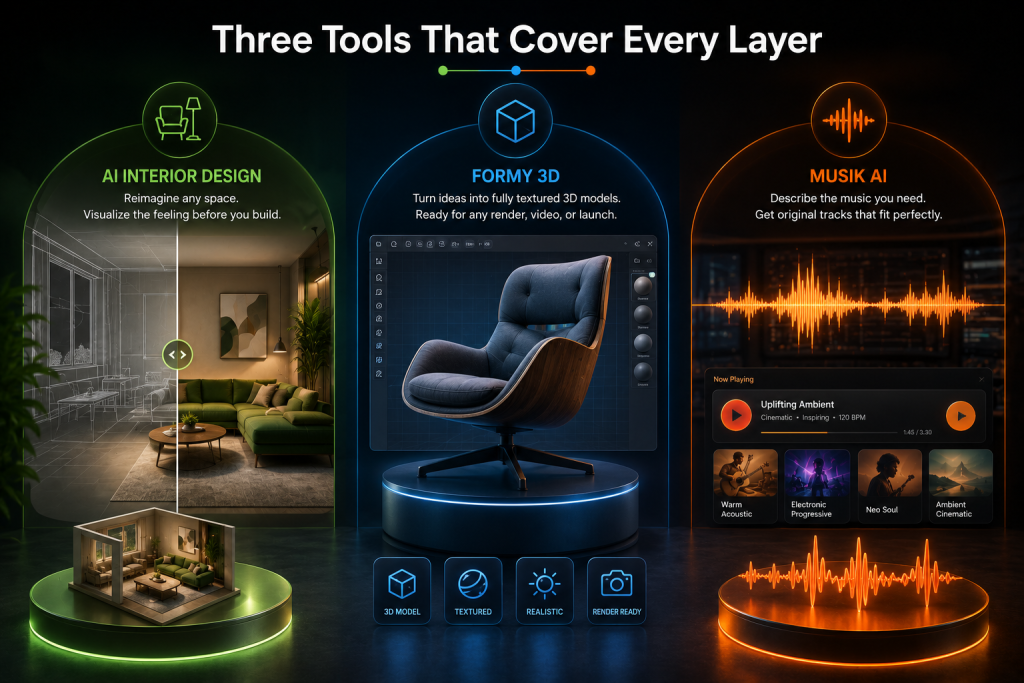
[AI Interior Design](https://ai-interior-design.net) handles the visual atmosphere of physical spaces. You upload a photo of a room, choose a style direction — Scandinavian, Japandi, Art Deco, two dozen others — and the AI transforms the space in 4K resolution, reimagining surfaces, furnishings, and light while preserving the room’s actual proportions.
The specific value here is that you can design the *feeling* of a space before committing to anything physical. A renovation, a retail environment, a studio, an office — these are spaces that create an impression on everyone who enters them. Getting that impression right before spending money or time is a different kind of leverage than most people have access to.
[Formy 3D](https://formy3d.com) sits in the middle layer — the objects and products that live inside the space, or that anchor a launch, a pitch, or a brand visual. You describe what you need in text or upload a reference image, and it generates a fully textured 3D model ready to use in renders, videos, product pages, or presentations.
This is the layer most people skip when they’re moving fast. The space looks right. The music sounds right. But the product itself — the thing you’re actually selling or showing — exists only as a flat photo or a rough sketch. Having a 3D model that you can rotate, light properly, and drop into any context changes what your visuals can do.
Musik AI](https://musik.tools) does the equivalent for sound. You describe the music you need in plain language — the mood, the genre, the energy level, the instrument textures — and it generates an original track. Not a stock track. Not something someone else already used in their Tuesday product demo. Something made specifically for what you described.
The sample outputs on the platform give you a sense of the range: warm folk acoustic for a brand story, progressive house for a high-energy launch moment, neo-soul for a relaxed product feel, ambient guitar textures for something that should fade into the background without disappearing. The genres and moods are specific enough to be actually useful.
Why These Three Work Together
Space, form, and sound seem like separate domains. But they’re doing the same work from different directions — shaping how an experience feels to the person inside it.
Think about the last time you encountered a brand that felt genuinely coherent. The environment felt right. The products looked like they belonged in it. The audio — in the video, at the event, on the site — matched the same emotional register. You probably couldn’t articulate why it worked. You just trusted it.
That coherence is what these three layers produce when they’re aligned. The space creates the context. The product occupies it with the right presence. The sound confirms the mood. Pull any one of them out of alignment and the whole thing loses conviction.
For most of the history of design, each layer required a separate specialist. The interior designer handled the space. The product modeler handled the form. The music supervisor handled the sound. Small teams and solo creators had to choose which layers to design intentionally and which to approximate.
These tools make it practical to cover all three without a full production team behind you.
The Specific Moments Where This Changes Things
Renovation and real estate: You’re designing a space to feel a certain way — calming, energizing, sophisticated, warm. AI Interior Design lets you visualize that feeling before touching a single wall. Musik AI lets you test what music actually suits the finished space — useful for retail, hospitality, or any commercial environment where audio atmosphere is part of the product.
Product launches: The space is designed, the campaign visuals are ready — but the product itself only exists as flat photography. Formy 3D fills that gap with a textured 3D model you can light, rotate, and place in any context before a physical prototype exists. Pair it with a Musik AI track built for the same launch energy and you have a complete asset set without a studio day.
Content and brand video: Your launch video has a visual tone. Does the music match it? Does the product visual match the space it’s shown in? Generating all three from the same creative brief — environment, form, and sound — means fewer moments where one layer undermines another.
Events and presentations: The room looks right. Does it sound right when people walk in? A few minutes in Musik AI to generate something that matches the visual intent you’ve built is faster than it has any right to be.
Solo creators: You’re designing both the aesthetic and the sonic identity of your content, your brand, your environment. Having access to both tools without needing a team changes what’s possible at the individual level.
The Bottom Line
The experiences people remember aren’t just well-designed in one layer. They’re coherent across all of them — the space, the objects inside it, and the sound that fills it are all saying the same thing.
If you’ve been designing one layer at a time and approximating the rest, these three tools let you close those gaps intentionally. Pick the layer you’ve been neglecting most and start there. Describe the mood you’re after. See what comes back.
Follow me if you want to keep finding the tools that close the gaps everyone else leaves open.
