

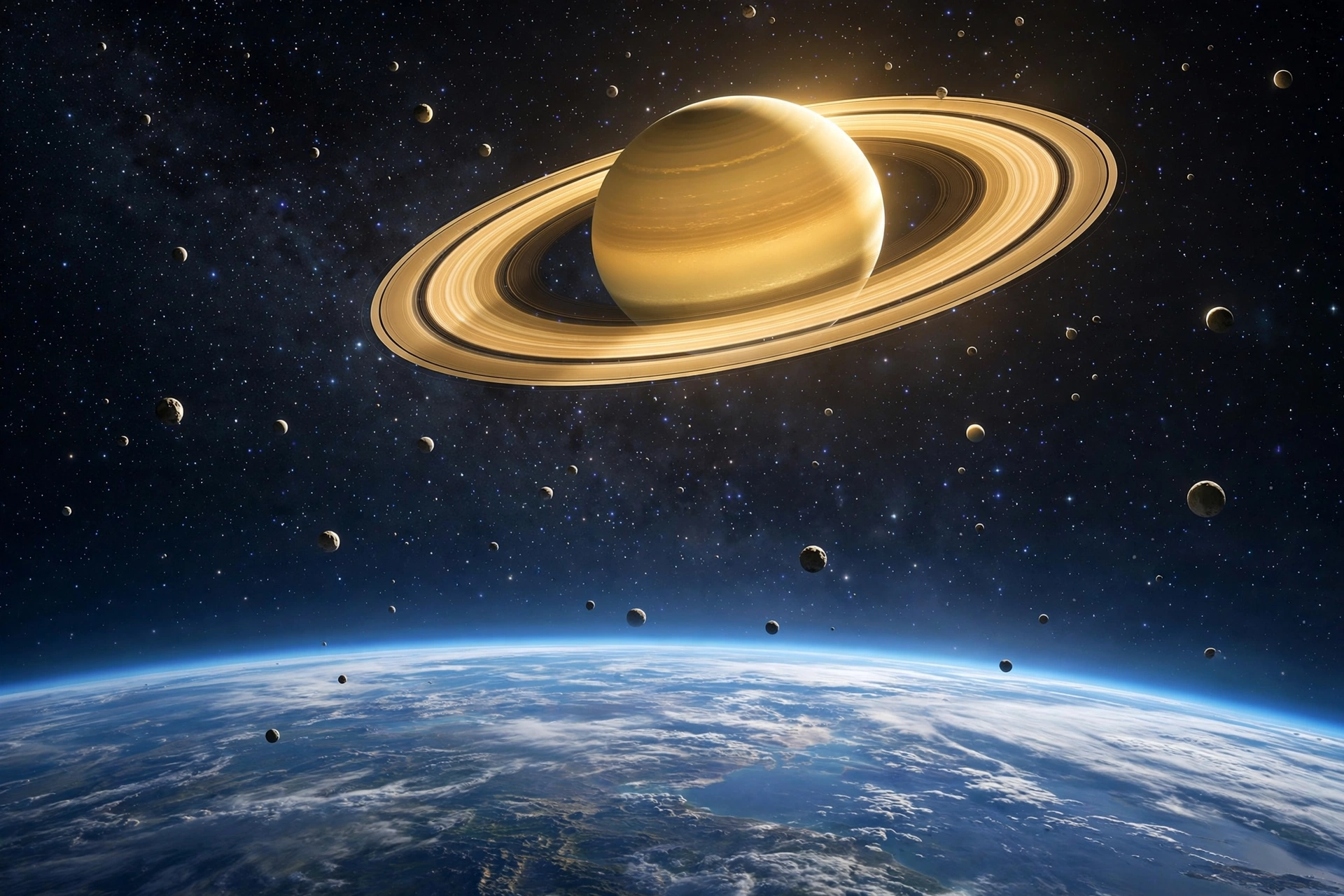
Saturn’s entourage has grown to almost implausible proportions. Astronomers have confirmed 128 new moons in orbit around the ringed giant, pushing its total to 274 and giving the planet the most extensive moon system ever catalogued. The announcement follows a multi-year survey using the Canada-France-Hawaii Telescope, one of the world’s most productive instruments for hunting faint objects in the outer solar system.
Scientists at the University of British Columbia are among those credited with the work, which required linking detections across several observing seasons until each candidate’s orbit could be certified. The International Astronomical Union has recognised the additions, making the record official.
Not the moons you grew up with
Textbook diagrams show Saturn with a handful of big, bright moons such as Titan and Enceladus. The newly confirmed bodies are nothing like them. These irregular moons are fragments of rock and ice a few kilometres wide, orbiting millions of kilometres from the planet on tilted, looping paths that can take years to complete.
Their strange orbits are the clue to their origin. Rather than forming from the disc of material that built Saturn’s orderly inner system, irregular moons are widely believed to be captured wanderers — small bodies that strayed too close and never escaped, later breaking up in collisions.
Families written in orbits
Group the newcomers by their orbital similarities and a pattern emerges: clusters of fragments that almost certainly began as single parent bodies. Reconstructing those families is one of the most valuable outcomes of the survey, because each break-up preserves evidence about conditions in the young solar system.
There is a pleasing parallel with events much closer to Earth. Just as observers pieced together the story of the SpaceX rocket launch jellyfish cloud over the US East Coast from many separate sightings, astronomers assembled these moons from many faint traces — in both cases, patience turned fragments of evidence into a coherent picture.
How the search works
The survey’s core trick is image stacking. Dozens of exposures of the same region are combined while compensating for Saturn’s motion, so genuine moons accumulate light and emerge from the noise while stars smear into streaks. Promising dots are then re-observed until their orbits are secure enough for formal recognition.
It is slow, unglamorous work, and deliberately so: a catalogue is only useful if every entry can be found again. That reliability is what elevates a list of candidates into a confirmed census of 274.
A record with room to grow
Astronomers are careful not to call 274 the final answer. Detection limits, not nature, set the current boundary, and there may be smaller moons still awaiting discovery when more sensitive surveys turn to Saturn. Each improvement in instrumentation throughout history has enlarged the family, and there is little reason to expect the pattern to stop now.
From Galileo’s puzzle to a digital census
Saturn has been confusing astronomers since telescopes first turned towards it. Galileo saw odd appendages he could not explain; later observers resolved them into rings, then began picking out moons one by one as instruments improved. For most of that history, each new moon was a notable event in its own right, announced individually and debated on its own merits.
The modern era works differently. Surveys now harvest candidates in bulk, and computers perform the first pass of detection before human eyes get involved. Announcing 128 moons at once would have been inconceivable in the age of the eyepiece, not because the moons were absent but because the workflow to certify them did not exist. The record of 274 is therefore as much a milestone in method as in astronomy — proof that systematic, software-driven searching has permanently changed what a census of the solar system can mean.
Even so, the gap Saturn has opened is formidable. The planet has become the definitive example of how a giant world’s gravitational reach can gather, capture and curate hundreds of small companions — a system whose full story is only now coming into focus.
