

Actuator type changes power demand, timing, sound, monitoring, control logic and sensitivity to mechanical load.
For: access-control integrators, security consultants, OEM product teams and electrical engineers | Technical review: TOPTEK Access
Choose actuation technology after defining the movement, duty cycle, power budget and required feedback.
| TL;DR Solenoids provide fast, simple state change but may require continuous holding power and careful coil-duty management. Motors can move a mechanism through a controlled stroke and may use power mainly during transitions, but they need direction, timing and stall protection. Compare the exact product’s electrical data and mechanical function; technology labels alone are not specifications. |
The quick answer
A solenoid and a motor can both be used inside an access-controlled mortise lock, but they do not necessarily move the same component. One product may use a solenoid to enable or disable a lever; another may use a motor to retract a latch or drive a bolt. The integration consequences follow the actual movement, not the marketing category.
Ask for an electrical interface sheet and an operating sequence. It should show voltage range, normal and peak current, energization time, duty rating, polarity, fail mode, command duration, monitoring outputs and mechanical override.
Solenoid strengths and trade-offs
A solenoid converts electrical energy into a short linear movement and can change state quickly. The control circuit can be simple, particularly when the coil directly controls a lever clutch or locking element. Depending on the design, power may be required continuously to hold one state.
Continuous energization creates heat and power-budget considerations. The integrator should know whether current is steady, reduced after pull-in or limited by duty cycle. Coil voltage tolerance, suppression of electrical transients and the response to undervoltage also matter.
| Selection principle Specify the commanded mechanical action first. Then select an actuator whose power, timing and feedback fit that action. |
Motor strengths and trade-offs
A motor with gearing can provide controlled travel and may consume power primarily while moving. It can support functions that need a defined stroke or bolt retraction rather than a binary clutch state. Position switches or current sensing may provide useful feedback.
The design must handle run time, reversal, end-of-travel, stalled conditions and repeated commands. High friction from a loaded latch or misaligned strike can increase current or prevent completion. A motorized lock should not be treated as a cure for poor door mechanics.
Power supplies must be sized from measured events
Use peak/inrush and holding current for the exact voltage, wire length and number of simultaneous openings. A nominal supply wattage does not guarantee adequate voltage at the lock after cable drop. Define whether doors can operate simultaneously during an emergency or mass-unlock event.
TOPTEK’s European solenoid-controlled self-locking range is designed around 12–24 V DC flexibility, while exact current and control details remain model-specific. The integrator should request the current revision of the datasheet before panel and cable sizing.
Feedback should describe physical outcome
A relay output from the controller confirms that a command was sent. It does not prove that the lever enabled, latch retracted, deadbolt projected or door closed. Select monitoring points—door position, latch/bolt state, request-to-exit, tamper or cylinder use—according to the security and life-safety risk.
Commission by creating realistic loads. Test with the door closed into final seals, a normally adjusted closer and the expected strike engagement. Repeat at minimum and maximum supply conditions and after multiple cycles to reveal heat or stall issues.
Motorized versus solenoid integration
| Factor | Solenoid tendency | Motorized tendency |
| Movement | Fast linear enable/disable action | Controlled rotary/linear travel through gearing |
| Power profile | May have pull-in plus continuous holding load | Often higher during movement, low when idle |
| Control | Simple energize/de-energize logic | Direction, run time, end-stop or controller logic |
| Heat/duty | Coil temperature and duty rating are important | Stall, repeated travel and gearbox load are important |
| Mechanical load | May fail to change state under binding | May draw more current or time out under binding |
| Monitoring | State switch may be available | Position/current feedback may be available |
| Best comparison | Exact lock function and datasheet | Exact lock function and datasheet |
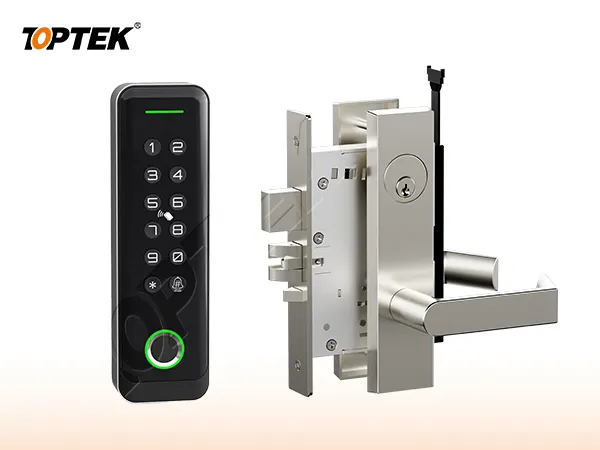
Electrified escutcheon-format example: actuator choice must be coordinated with the mechanical function and controller.
Integrator data request
▪ Exact lock model, function, handing and fail-safe/fail-secure configuration.
▪ Rated voltage range, polarity, peak current, holding current and duty limits.
▪ Command type and required pulse, hold or direction logic.
▪ Time to change state and behavior during undervoltage or interrupted command.
▪ Available door, bolt, lever, request-to-exit and tamper monitoring outputs.
▪ Maximum permitted mechanical load and strike/door alignment requirements.
▪ Mechanical key override and free-egress sequence.
▪ Cable gauge/length, power-transfer path, suppression and panel battery calculations.
What a capable manufacturing partner should provide
TOPTEK’s electronic lock and access-control range includes ANSI-format electrified mortise locks and European self-locking solenoid-controlled families. The exact model sheet should define the function and electrical values used in panel design.
When a standard product does not match the controller or door system, early co-engineering is more efficient than field adapters. TOPTEK’s electronic engineering resources can support interface review and prototype validation for OEM/ODM projects.
Frequently asked questions
Are motorized locks always lower power?
Not always. Their idle profile may be low, but peak current, travel time, gearing and frequency of operation must be considered for the exact model.
Are solenoids always fail-safe?
No. The mechanism can be designed for fail-safe or fail-secure behavior. Confirm the exact configuration and power-loss state.
Can controller relay ratings be used to size the lock supply?
No. Use the lock’s electrical data, cable voltage drop, simultaneous-operation scenario and listed power-supply requirements.
| Engineering takeaway Choose the movement before the actuator. Share your controller I/O, power budget, duty cycle, door function and monitoring needs with TOPTEK so the lock and system interface can be validated together. |
