

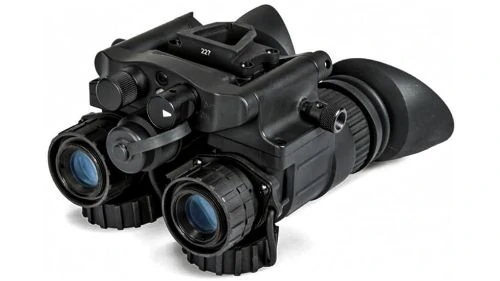
Night vision goggles (NVGs) are used to see clearly in conditions that are conducive to night time. They have successfully been adopted as an important accessory in the arsenal of the military, police or other security forces that require efficiency during the night.
However, there are some details and differences that can make NVG binoculars quite different, even within the same NVG brand.
Let us dive deeper and define those 12 capabilities that make NVG binocular truly shine and are worth focusing on.
1. Image Intensifier Tubes
The image intensifier tubes are widely regarded as the backbone of any set of night vision goggles. They collect the existing natural light in the surrounding and increase it to thousands of folds for visibility of objects in the dark. The quality of these components defines the possibility of obtaining a clear image and the range of conditions for NVGs to work.
2. IR Illuminator
It is worth noting that most of the NVG binoculars are equipped with an in-built IR illuminator. This is because it enables one to see in completely dark environments where there is no source of light to intensify the unit. To view objects and terrain in total darkness, the IR illuminator emits invisible near-infrared light, which goggles then magnify.
3. Magnification Level
Magnification ability in excess enables one to observe objects at a farther distance with increased clarity. In most NVG used as binoculars, the magnification varies from 1x to approximately 5x. 3-4x instruments are of ideal augmentation and provide a wide angle of view. More power reduces the field of view but allows observation to be done from a greater distance and in more detail.
4. Objective Lens Diameter
This also works to influence light-gathering capacity, the width of the field of view on NVG binoculars, and the diameter of the objective lenses. Typically, lenses are standard size of 27mm to 40mm or even slightly smaller in some cases. The objective lenses with larger numbers collect more light and perform well in low-light conditions. But they also add to the weight of the vehicle and thus could be a problem in certain circumstances.
5. Detection Range
The detection range is best seen when it comes to the capacity that it can offer in different lighting conditions. With good-quality NVG binoculars, one can see up to 300 meters or more in a blacked-out environment, or such further distances as when viewing under a starry night, with the help of an IR flashlight, or with some ambient light.
6. Brightness Gain
Brightness gain represents a proportion by which objects look brighter when viewed through goggles compared to their appearance in normal, unaided vision. Models with higher brightness gain make scenes appear brighter than they actually are so that scenes become brighter and easier to observe. Light amplification of 20,000 to 50,000+ is typical for high-end NVG binoculars for combat use.
7. Resolution
This assesses students on how much detail they can see through the goggles. Resolution is usually defined in terms of a line pair per millimeter (lp/mm). Models with a resolution of 40 lp/mm and above will give you sharp images with a high level of detail, permitting one to see small objects or sudden movement.
8. Signal-to-Noise Ratio
The signal-to-noise ratio describes the level of distinction between the figure and the ground, or image brightness relative to the background noise. A high ratio implies a higher quality of images with less interference, such as noise. Instead, I recommend selecting units with a S/N ratio above 30 for better image quality.
9. Autogating
Autogated units help to control lighting situations and intensity of amplification in order to provide favorable views. Again, it is ideal for adjusting visibility when the ambient light changes, and you do not need to use the manual knobs. Autogating also helps in shielding of the intensifier tubes in cases where there is exposure to bright light.
10. Power Options
The most common batteries used in NVG binoculars are AA or CR123, both of which are readily found in stores. Some of the higher-end models have their own re-chargeable battery packs for ease of use and lower running expenses. Some of them also have battery life indicators to give the user an idea when the unit is low on power.
11. Rugged, Waterproof Housing
Since NVGs are mounted, operated and used in rough environments, the exterior must be strong enough to prevent cracking and withstand water, dust, etc Rubber armor also reduces shock. While looking for binoculars, consider those that have magnesium or composite housing and are described as waterproof and/or fog-proof.
12. Mounting Compatibility
For instance, you will need NVG binoculars that can be easily affixed to the various tactical helmets that you may be using when a hands-free operation is required. The helmet-mounted models are compatible and have specific fittings and eyepiece placements. This makes sure that the field of vision remains unhindered by any obstructions when the shooter is in a standing or prone position.
Final Words
When using the NVG binoculars at night, having the right capabilities for your binoculars ensures that you remain unseen while being aware. Look for units that provide high-intensity intensifier tubes, superior-quality optics, good light magnification, and durable housing, especially those created for use in rough field conditions.
