

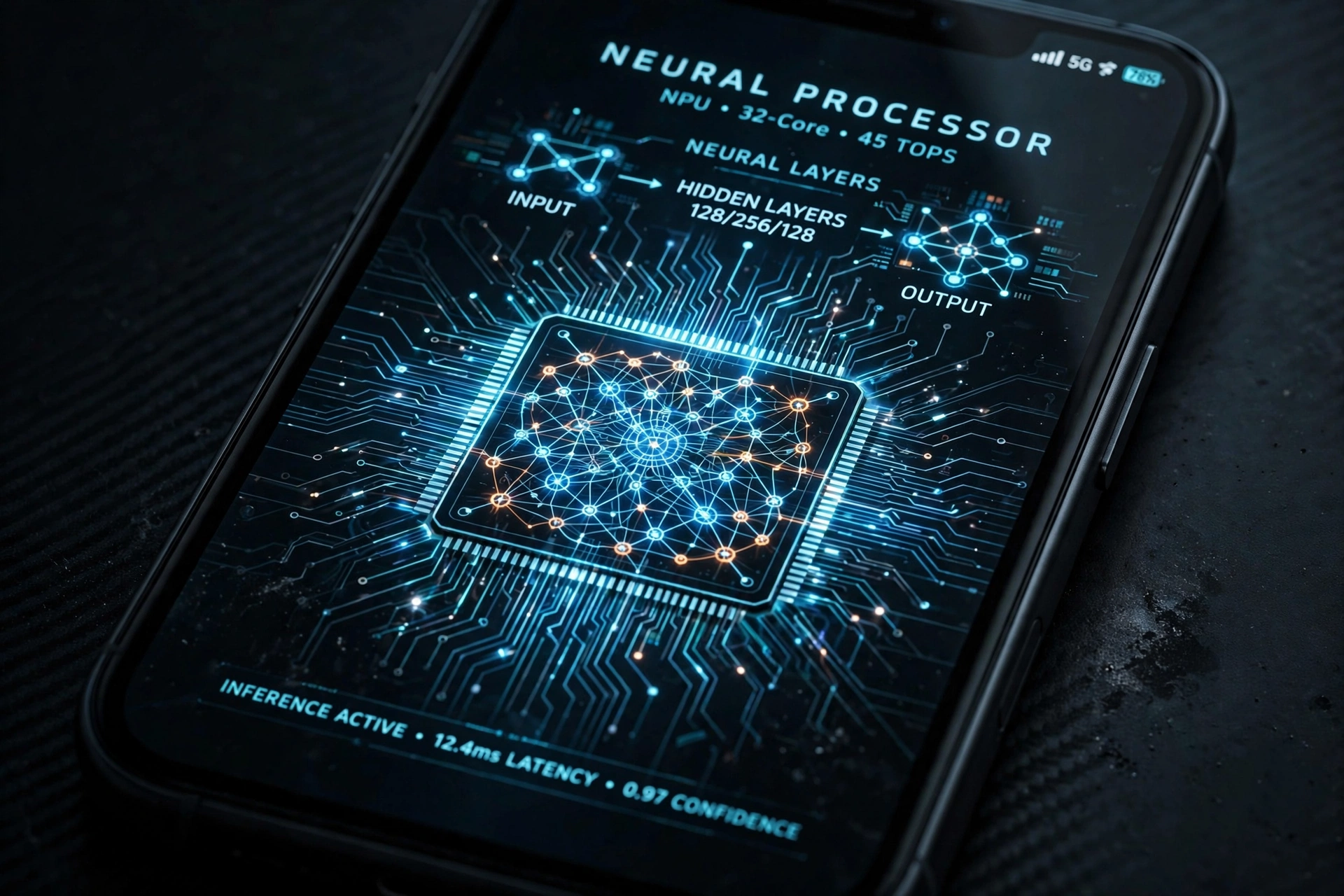
For a decade, artificial intelligence lived in someone else’s building. Your phone was a window; the thinking happened in distant data centres, and every question you asked travelled across the internet and back. That architecture is now quietly reversing. The most consequential AI shift of 2026 is not a bigger model in the cloud — it is capable models moving onto the device in your pocket, and it changes privacy, speed and cost all at once.
Why the Move Is Happening Now
Three curves crossed. Neural processing units in flagship phone chips now deliver tens of trillions of operations per second, the kind of throughput that once required a server rack. Model compression matured at the same time: techniques like quantisation shrink large models to a fraction of their size with surprisingly little loss of quality. And memory bandwidth — the unglamorous bottleneck of on-device inference — roughly doubled in two hardware generations.
Chipmakers such as Qualcomm, whose AI platform work is detailed at qualcomm.com, now market on-device AI as the default tier: translation, summarisation, image editing and voice assistance running locally, with the cloud reserved for the hardest queries.
What Changes for You
Latency disappears. Dictation, live translation and photo search respond instantly, on a plane, in a tunnel, in a village with one bar of signal. Privacy improves structurally rather than by promise: a request that never leaves the device cannot be logged, leaked or subpoenaed from a server. Google’s writing on this hybrid approach, at blog.google, describes systems deciding per-request whether a task runs locally or in the cloud based on complexity and sensitivity.
There are costs. On-device models are smaller and sometimes noticeably less capable than their cloud siblings. Inference drains battery and warms the phone during long sessions. And capability now stratifies by handset: the AI features of a two-year-old budget phone and a new flagship increasingly belong to different eras.
The Hybrid Settlement
The emerging consensus is neither pure cloud nor pure device, but routing. Quick, private, repetitive tasks — rewriting a message, transcribing a meeting, identifying a plant — stay local. Novel, enormous or knowledge-heavy tasks escalate to data centres. Operating systems are becoming traffic controllers for intelligence, and the user rarely notices the hand-offs.
Developers feel the shift too. An app that runs its model locally pays no per-query cloud bill and works offline by default, but must ship and update models within app-size limits. Expect a new optimisation discipline — part machine learning, part diet plan — to become a core mobile skill.
The Strategic Stakes
Whoever owns the on-device layer owns the customer relationship. If the phone’s built-in assistant handles most requests natively, third-party AI apps lose their front door, and cloud providers lose the query volume that funds their infrastructure. That is why the platform owners are investing so heavily, and why regulators are watching the default settings. The cloud is not dying; the biggest models will live there for years. But intelligence is becoming like computing itself did a generation ago — something that used to require a mainframe, now riding along in your pocket. We will keep tracking the handset race in our technology coverage.
